Posted on Leave a comment

The Long Journey Home

After a few days of hunting, Dax and Geoff packed up to head home. Their first stop: nearby Atikokan to gas up. But the clouds started to drop fast, and so they headed to their alternate: Thunder Bay International airport.

1moose17

After a quick fill-up at YQT, the guys headed out over the Sleeping Giant that is Thunder Bay (below), back towards Marathon.

7moose-sleeping-giant

A half-hour later, over Lake Superior, above some scattered clouds, the electrics on the plane – radio, GPS and more – started to go out, one by one. With his trusty handheld radio, Dax turned around and headed back to a seaplane base in Thunder Bay. The flaps crept down, using the tiny bit of battery power that remained, and the landing was smooth.

On land, Dax had a technician look at the plane. With the help of several local pilots (and the helpful folks at Wilderness North), they determined the plane was safe to fly, but Dax would have to charge up for the night – and conserve energy on the journey home.

moose-lux

The fellows now found themselves, unexpectedly, with a night to kill in T-Bay. And so they did what anyone in that situation would do. They headed to Prospectors Steak House. And then, a dodgy motel (above).

3moose19

The next morning, Dax visited the legendary Finnish Hoito restaurant for the first time; a crucial rite of passage for Dax, whose mom is Finnish.
4moose20

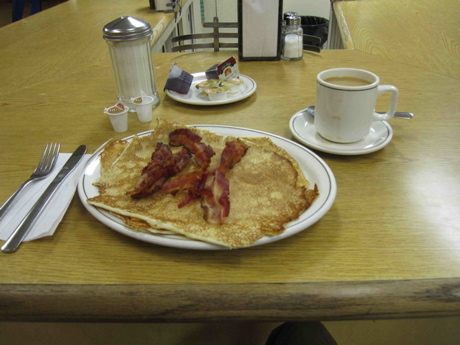
What does one eat at the Hoito? Finnish pancakes and bacon, of course.

6moose27

Dax’s early-morning ambitions were thwarted, sadly, by a thin layer of frost.

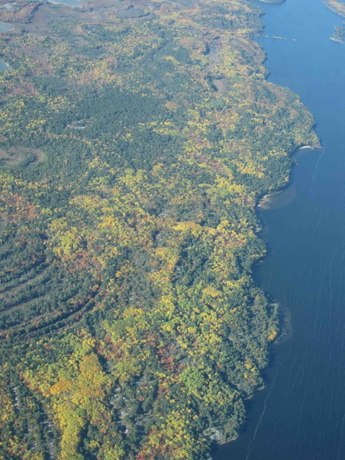
Once the frost disappeared, the day turned downright beautiful. Above, a view of the oceanic Lake Superior.
2moose-10-aird

After a smooth take-off and a stop in Wawa to recharge, Dax continued south, following a pole line – and then the little lakes on the map. Below, a familiar sight: Dax flies over a colourful Aird island, where the Wilkinsons have their family camp.

8moose28

That’s some good old-fashioned navigating. And it worked like a charm: Dax landed later that day at the Toronto Island Airport without a problem.

Posted on Leave a comment

Dax’s Lessons from the Bush

moose-photo-stand-lessons1

No doubt, 1100 kilometres is a long way to travel for five days, and – if you’re lucky – one good look at a moose. And so, when a man comes tantalizingly close to a good shot, but doesn’t quite get it, it can inspire some reflection. So it did for Dax, who spotted a monster of a moose as it turned and started to run away.

Dax may not have come home with much to show, he did learn three important lessons:

1. Don’t glass the far terrain before you look at the area close to you.

2. Make sure your scope is at minimum power and go up from there. Mine was zoomed in, set to look far away, so by the time I saw the moose, which was closer to me, it was too late.

3. If you can’t get a shot that will do the trick, then don’t take it. No matter how much you hear about it back at camp, you should never regret it!

Posted on Leave a comment

An Autumn Adventure

1moose-marathon

On a cloudless Friday last month, Dax set out for five days of moose-hunting in Kashabowie, which is just northwest of Thunder Bay. The journey from Toronto – about 1100 kilometres – was Dax’s longest as PIC (Pilot in Command).

Along with his pal Geoff Benic, Dax made a stop in Elliot Lake to refuel the plane – and then Marathon, to refuel the pilot (above). From there, the fellows flew over the northern edge of Lake Superior (perhaps right over the wreck of the Edmund Fitzgerald!), past Thunder Bay, to Kashabowie Lodge, where they landed. They hopped into a truck that Geoff’s brother, Jimmy, and his father, Walter, had left waiting, and off to camp they went.

2the-list

Every epic adventure begins with an epic list.

3moose-heaven

The great, great outdoors.

4moose-104

Above, what Dax calls “my perfect moose heaven spot.” It was near here that he spotted a giant bull moose – running in the opposite direction. In spite of his most enthusiastic moose-heckling, Dax couldn’t get a clear shot.

5moose-fox

Spotting moose is tough. The foxes however, were everywhere.

A pack of timber wolves, as seen through the ocular of Dax’s binocs.

7superdry1

Back at camp.

8moose-102

At the end of the day, Dax consoles Walter, who narrowly missed a small bull earlier. A shot of grappa will numb that pain!

9moose-sat-tv

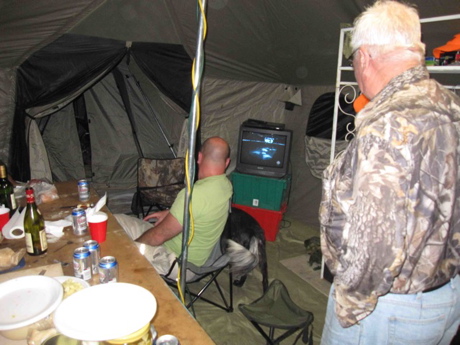
What would a hunting camp be without some D-I-Y satellite TV?

10moose-sunset1

The sun sets. Tomorrow is a new day. Tune back in this week as we recount the rest of the trip.

Posted on Leave a comment

Dax Wilkinson: Sharpshooter

The MilCun Training Centre, at the MilCun Marksmanship Complex, is mecca for aspiring sharpshooters. Run by veterans of the competitive shooting circuit, Capt. Keith A. Cunningham and Linda K. Miller, the verdant, 700-acre facility offers everything from introductory training for new hunters to high-level “mental marksmanship” courses for snipers.

Dax headed to Haliburton (about two hours northeast of Toronto), along with Jimmy, Geoff and Walter Benic, for some practice in advance of their moose hunting expedition.

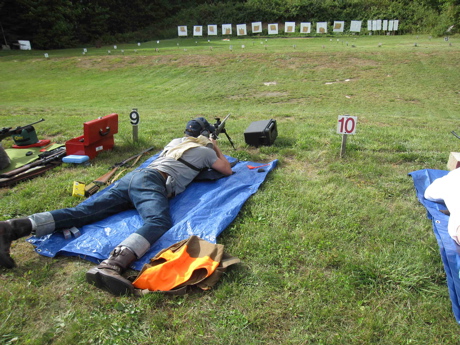
marksman1

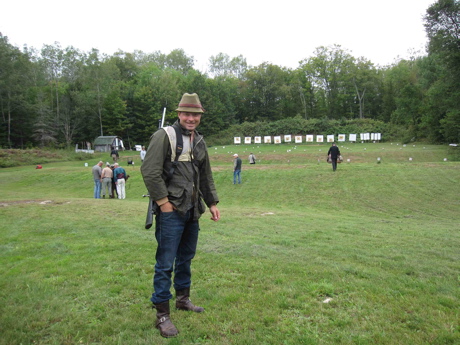
Dax arrived with a solid knowledge of the first lesson of the shooting range: Always be ready (to have your photo taken).

marksman2

Here, Dax takes aim with his whitetail deer gun –  a Tikka T3, 7MM-08.

marksman3

The key to sharpshooting success is focus, a keen eye, steady hands – and a great cap.

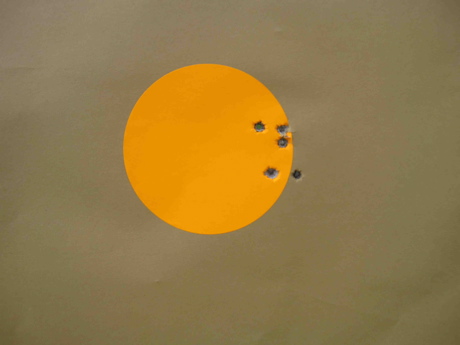
35-inch-circle

We rest our case.

Posted on Leave a comment

Meeting Mr. Branson

branson

Above, esteemed entrepreneur and business icon Dax Wilkinson poses beside some hippie.

Just kidding. Dax recently had the opportunity to meet Sir Richard Branson at a fundraiser in Toronto for Branson’s Virgin Unite charity. The fellows chatted for a few minutes about aviation, space travel and Yellowknife, where Dax recently visited, and where Mr. Branson once crashed a hot air balloon. Branson was down-to-earth and quite friendly. He even invited Dax to tag along on a Virgin Galactic journey into space. Dax was keen, until he learned of the “spacefare”: about $200K. Perhaps he can fly standby?

Posted on Leave a comment

A Cessna 150, Revived

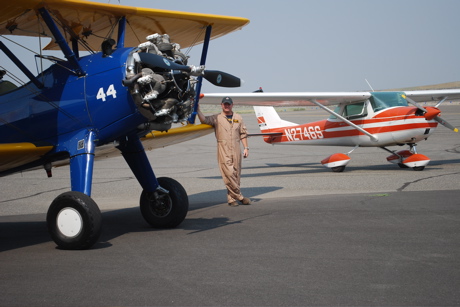
Scott Urban, a Red Canoe customer from Pasco, WA, recently sent us some photos. “The photos are of my 1967 Cessna 150G and my 1943 Boeing Stearman PT-17,” he told us. “I bought the Cessna 150 in a pile of parts about 10 years ago and restored it; it hadn’t flown since 1977. I bought the Stearman in spring of 2010, and in May, I flew it from Wisconsin to Washington State – about 1500 miles. This Stearman started its life as a Navy N2S-5 version, training pilots during WWII. It was later sold as surplus to a crop-duster in Texas, and then restored to its current configuration as Army Air Corps PT-17. Both aircraft are an absolute pleasure to fly.”

To thank Mr. Urban for his letter, we’ve sent him a Boeing Experimental Flight Test cap.

Please, tell us your story, and send us pictures, too. If we post it on the blog, we’ll send you a piece of Red Canoe swag to say thanks. Email us here, or mail your pics to this address.

scott-urban

Mr. Urban stands proud, wearing our USAAC roundel cap.

boeing-stearman-pt-17

Above, the Boeing Stearman PT-17.

cessna-150

Above, the Cessna 150G.

Posted on Leave a comment

The World’s Most Beautiful Axe

Earlier this month, Dax visited David in New York for some brotherly love – and a series of meetings and appointments. A highlight of the trip, no doubt, was the visit to the studios of the Best Made Company, where Canadian native Peter Buchanan-Smith puts the finishing touches what could be the world’s finest axes: Hand-forged and hand-tempered in Maine by one of America’s oldest axe makers, there’s no doubt these axes live up to the Best Made name.

best-made-4

Best Made Axes are known for their colourful handles, which Peter paints in the studio. Here, a small batch dries.

best-made-2

Peter takes Dax through the finer points of axe craftsmanship.

best-made-6

Above, Dax gets a good look at Best Made’s “The National” axe, which celebrates Team Canada’s gold medal win in hockey by marking the date and time of Crosby’s goal, and an “87,” for Crosby, of course.

best-made-7

David, Peter, axe.

best-made-5

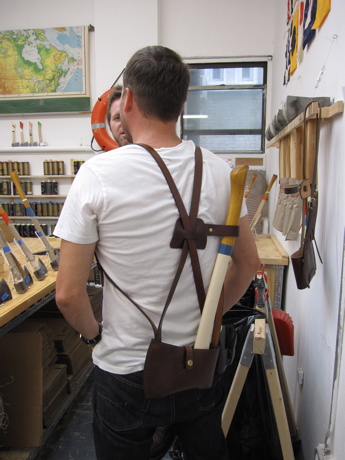
Dax tries on the handsome – and handy – leather axe carrying case.

Below, check out part five of Best Made’s very cool video series, CHOP.

CHOP No. 5 from Peter Buchanan-Smith on Vimeo.

Check out the rest of the CHOP series here.

Posted on Leave a comment

Off to the (Air) Races!

daves-host-standing-in-plane

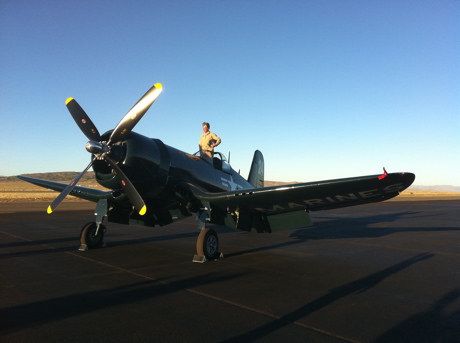
Last month, David headed to the Biggest Little City in the World, sunny Reno, Nevada, for the 47th Annual National Championship Air Races & Air Show. At the event, pilots race in a range of aircraft classes, from biplanes, like the Pitts Special and the Mong, to souped up WWII-era fighter jets, like NAA P-51 Mustangs and Grumman F-8F Bearcats, which can reach speeds of more than 800 km/h.

Above: Aviation legend Doug Mathews, who invited David to join him in the pits, stands tall and proud in his sparkling Vought F4U Corsair, a revered WWII and Korean War plane.

reno

Reno, Nevada: Where the city’s small, but the dreams are huge.

view-from-pit

The view from the pit: RVs, airplanes and the Sierra Nevada.

pit-crew-reading

What are the Air Racing pit teams reading these days? The Red Canoe 2010 catalogue, of course. (You can, too. Click here to download the PDF.)

galloping-ghost

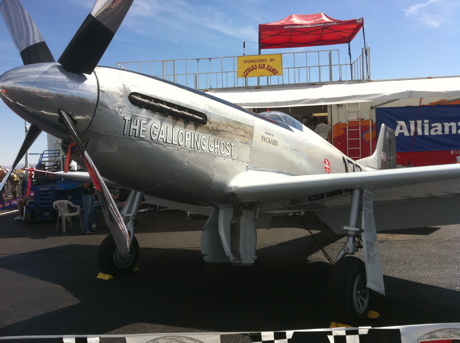
Sweet racing planes are everywhere at this event. Above, the very slick looking Galloping Ghost.

canada-represents

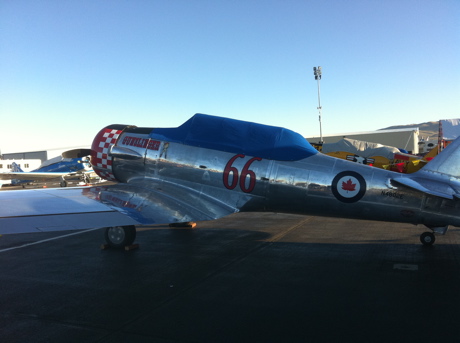
Canada represents with the Gunslinger.

sweet-usac-plane

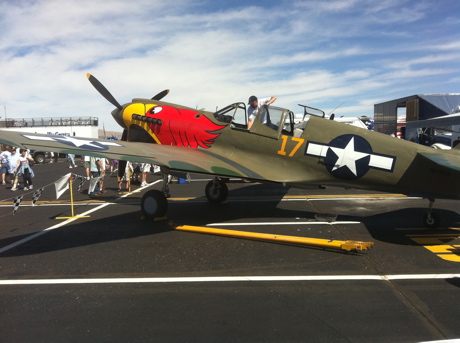
The Curtiss P-40 Warhawk, an iconic WWII-era warplane that’s been used, at various times, by 28 different nations.

snowbirds

Canada’s ambassadors in the sky: The Snowbirds do what they do best.

dave-naa-jacket

David (photographed by David), wearing the brand new North American Aviation Flying Jacket.

Posted on Leave a comment

True North, Part 4: The Journey Home

Over the past few weeks, we’ve been recounting Dax’s journey from Sudbury to Yellowknife – and beyond. Here, the final leg of the journey. (If you missed the other installments of this tale, catch up now with parts one, two and three.)

img_3257-landing-lake-churchill

Dax and co. set up to put into Landing Lake as they arrive to Churchill, Manitoba. The name is a touch misleading; the lake isn’t all that great for landing, thanks to shallow waters and ample rocks, but the fellows rose to the challenge. There were not, thankfully, any Beluga whales in the way – though the white beasts are a fairly common sight in this neck of the woods.

img_3264-gas-in-churchill

The horseflies were biting – like crazy – but you know what stung the most? Paying $3-plus a litre for gas at this tiny waterfront stop in Churchill.

img_3253-fortress-of-churchill

Here, the history of Churchill’s Prince of Wales Fort in 21 words (and four numbers): 1717: Hudson’s Bay Company builds it (in trading post form). 1782: With 22 manning the fort, the French conquer peacefully. 1783: HBC gets it back.

img_3316-old-dock-pickle-lake

Pickle Lake was once a robust hub of bush plane activity; its waters were often buzzing with float planes, heading north with supplies. But things have quieted down in recent years – hence this dock’s shabby state of affairs.

img_3324-old-dock-pickle-lake

From Pickle Lake, the fellows made a quick stop in Geraldton. And then, finally, home.

Posted on Leave a comment

True North, Pt. 3: Max Ward’s Bush Camp

This summer, Red Canoe founder Dax Wilkinson hopped into a Cessna 185 Amphib and headed north – way north – to Yellowknife, NWT. We recounted the first leg of the journey here, and last week we shared some pics from Yellowknife. Today, we’ll answer the question: What does Dax Wilkinson do after traveling about 3000 km north? (Hint: It involves going further north. Of course.)

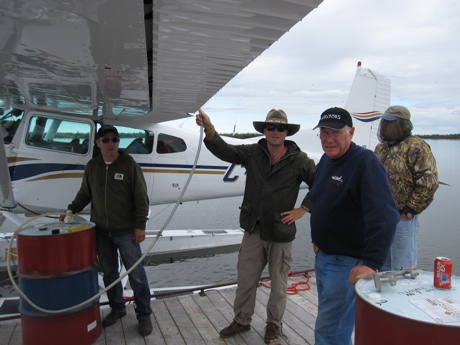
Dax and his crew received an unexpected – and most welcome – invitation to visit Rock Haven, the camp of Canadian aviation legend Max Ward. Ward, who flew with the RCAF in WWII, and founded the now-legendary Wardair in 1953 with a single De Havilland Beaver. (He’d started an earlier bush airline in 1946 with a De Havilland Fox Moth, which is now in the Canadian Aviation Museum.)

Here, some highlights of Dax’s adventures at Rock Haven, about 400 km north of Yellowknife.

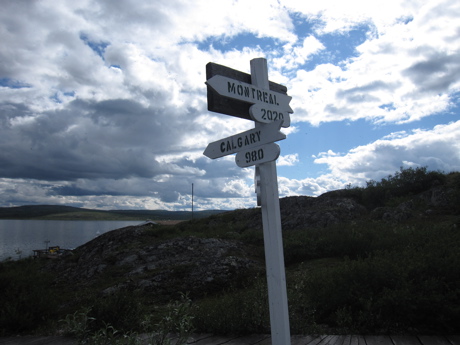
img_3135-location-of-wz

Where, exactly, is Rock Haven? See the sign, above, to get a rough idea. (That’s miles, not kilometres, by the way.)

img_3114-puddles-yk-to-wardzone-wz

When navigating the great north, every little puddle counts.

img_3149-sky-wz

Under bright blue skies, the crew arrives. Paradise? Found.

img_3141-dax-max-wz

Ward, who turns 89 next month, is said to have survived four crashes in the bush in his early flying days. Here, he shares some wisdom with a travel-weary Dax.

crerar

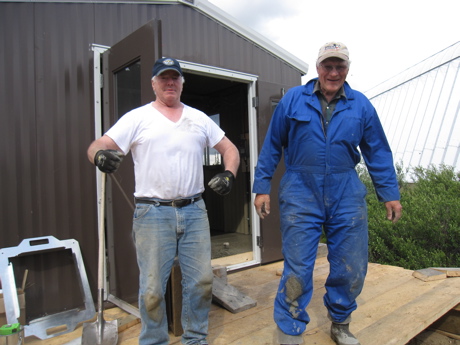
Dave Crerar (above, wearing a navy De Havilland cap), flies Max Ward’s Turbo Otter. Crerar is a virtuoso pilot, and he’s not afraid to get hands dirty: The muscles he’s flexing here were used to make a new concrete floor at the camp earlier that day.

img_3138-fishing-bugs-wz

There may not be many people this far north, but there sure are a lot of black flies and mosquitoes. Hence Pete Dozzi’s outfit, above.

img_3127-bugs-at-wz

Think Pete’s bug suit was overkill? Then see Exhibit A, above: The highest concentration of insects to ever sit on an RCAF Kit Bag.

img_3176-dax-fish2-wz

The lake trout were biting: Think a 10-to-20-pounder every five minutes or so. Here, Dax holds a 14-pounder caught by the eight-year-old son of a member of Max Ward’s A-team of engineers and pilots. The lad had caught and handled so many fish that day, he didn’t want to get his hands dirty with another. Dax didn’t mind. (The fish, of course, were all caught with barbless single hooks – and promptly returned to the water.)

img_3172-fish-tin-wz

A very cool relic from the Wardair days.

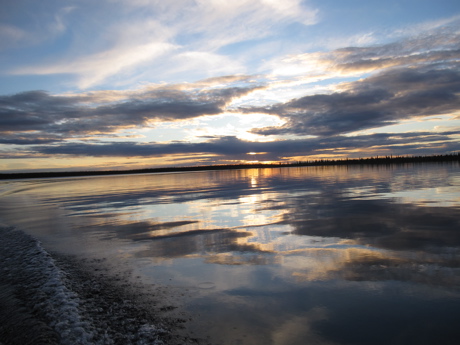
img_3166-midnight-wz

Sunrise, sunset. Up here, it’s almost the same thing. This shot was taken at midnight.

img_3118-from-above-wz

One look back as the fellows begin the long journey home.